

Epoxy resins are a class of reactive thermosetting polymers formed by curing an epoxide-containing resin with a hardener, producing a hard, chemically resistant material used across coatings, adhesives, flooring, and composites. Once cured, epoxy systems offer a rare combination of strength, adhesion, and chemical resistance that few other polymer families can match. In the world of high-performance materials, few chemical classes match the versatility, strength, and durability of epoxy resins. From heavy-duty marine primers guarding steel hulls against saltwater corrosion to seamless, high-gloss industrial flooring in commercial facilities, epoxy resins serve as the foundational binder for modern protective coatings, structural adhesives, and composite materials.
For chemical formulators, civil engineers, and industrial applicators, selecting the right resin base and curing agent is the single most critical decision in product development. This comprehensive guide breaks down what epoxy resins actually are, how they’re classified, the core chemistry of epoxy resins, their key physical properties, main industrial types, and primary B2B applications across the UAE, GCC, and global manufacturing markets.
What Are Epoxy Resins Made Of?
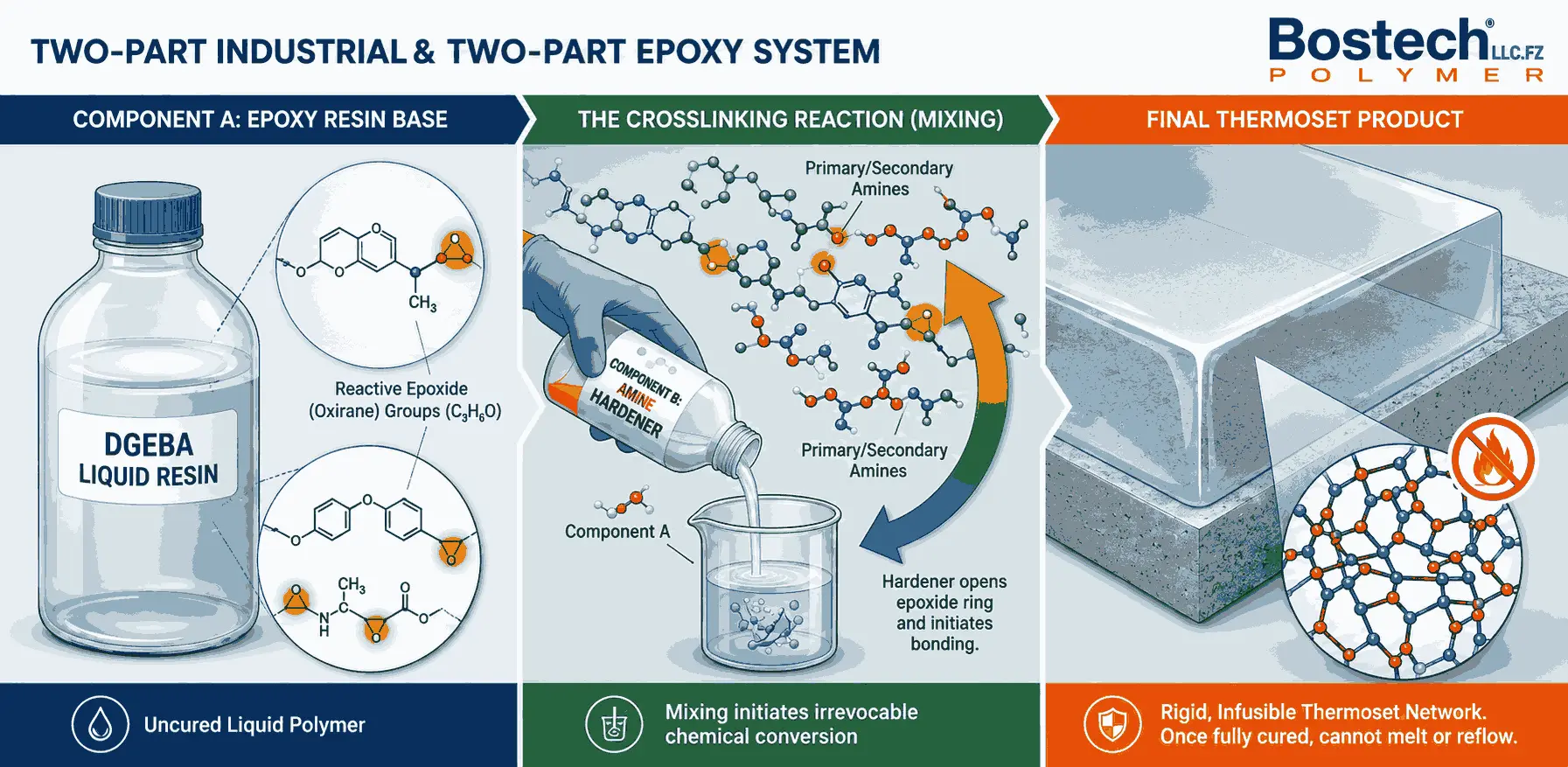
At its core, an epoxy system is a two-part chemistry: the epoxy resin itself, and a curing agent (commonly called a hardener). Neither component does much on its own; the resin remains a liquid or solid polymer with reactive epoxide groups, and the hardener remains inert, until the two are combined. When mixed, the hardener reacts with the epoxide rings (a three-membered ring consisting of two carbon atoms bonded to an oxygen atom) in the resin, triggering a crosslinking reaction that transforms the liquid or semi-solid mixture into a rigid, thermoset polymer network.
This crosslinking is what gives cured epoxy its defining characteristics: once fully cured, it won’t melt or reflow under heat. Unlike thermoplastic materials, which melt under heat and solidify when cooled, epoxies are thermosetting polymers. The strength of the final material, its flexibility, its heat resistance, and its cure speed are all determined by which resin and which hardener are paired together, which is why resin and hardener selection is treated as a single decision, not two separate ones, by anyone formulating with epoxy.
Most industrial epoxy resins are based on bisphenol A chemistry (reacted with epichlorohydrin), though variations exist for specialized performance requirements, including fire resistance and higher mechanical strength.
Types of Epoxy Resin
Epoxy resins aren’t a single, uniform product, they’re a family of materials that vary significantly by molecular weight, physical form, and intended processing method. Here are the main categories:
1. Bisphenol A Liquid Epoxy Resins (DGEBA)
Diglycidyl Ether of Bisphenol A (DGEBA) is the workhorse of the global chemical industry, accounting for over 75% of all epoxy resin consumed worldwide. Produced by reacting bisphenol A with epichlorohydrin, liquid DGEBA grades (such as standard SM828 equivalent liquid epoxy resins) offer an ideal balance of low cost, high mechanical strength, and easy processing.
- 828 / SM828 General Grade Liquid Epoxy Resin: Undiluted, high-purity Bisphenol A liquid epoxy resin (<180 EEW). The foundational benchmark for high-strength adhesives, industrial flooring, civil engineering grouts, and anti-corrosion coatings.
2. Solid, Semi-Solid & Solution Epoxy Resins
Higher-molecular-weight resins formulated for solvent-borne liquid coatings, heat-cured powder coatings, and heavy industrial maintenance primers.
- Solid Epoxy Resin E-12: High-molecular-weight solid resin used primarily in melt-processed powder coatings, high-durability pipe coatings, and can coatings.
- Epoxy Resin 75% Xylene Solution (e.g., RER 011 X 75 equivalent): Pre-dissolved solvent-borne resin designed for rapid blending into industrial maintenance primers and marine barrier coats.
- Semi-Solid Epoxy Resins: Medium-molecular-weight resins providing enhanced flexibility and chemical resistance for heavy-duty marine and tank linings.
3. Specialty & Functional Epoxy Resins
Engineered for specialized applications requiring strict fire safety compliance or extreme thermal performance.
- Brominated Epoxy Resin (BER): Flame-retardant epoxy resin engineered for electrical laminates, printed circuit boards (PCBs), and fire-rated industrial coatings where flame inhibition is required.
4. Bisphenol F & Epoxy Novolac Resins
Epoxy Novolac resins are produced by epoxidizing phenol-formaldehyde or cresol-formaldehyde novolac resins. Featuring a higher aromatic functionality per molecule (often 2.5 to 6 epoxide groups per chain) compared to standard DGEBA resins, they form an extraordinarily tight crosslinked network upon curing.
- Best For: Secondary containment linings, primary storage tanks handling hot acids or aggressive organic solvents, and high-temperature industrial coatings.
Epoxy Curing Agents and Additives: A Brief Overview
Since resin and hardener selection go hand in hand, it’s worth understanding the major hardener families at a high level.
- Polyamide hardeners — a widely used, versatile hardener family known for good flexibility and adhesion. Bostech Polymer supplies several grades across this family, including REH 115 (high-viscosity, high imidazole content) and REH 160 (low-viscosity polyamide curing agent), well suited to concrete primers and self-leveling flooring systems.
- Cycloaliphatic amine hardeners — generally offer superior heat distortion resistance and are favored for demanding industrial applications. REH 243 is a low-viscosity, moderate-reactivity cycloaliphatic amine curing agent that can be used standalone or blended with other amine hardeners.
- Phenalkamine, modified aliphatic, and castor oil-based hardeners — each of these families brings its own performance profile, from humid-climate suitability (phenalkamines) to bio-based formulation options (castor oil-based systems).
- Accelerators — not a hardener in themselves, but a co-additive used to speed up cure time. DMP-30 is a tertiary amine accelerator commonly used to shorten gel time in low-temperature conditions, particularly useful when paired with polyamide or amine-based hardeners.
- Reactive Diluents — Reactive diluents are lower-viscosity components blended into epoxy formulations to reduce overall system viscosity, making application easier without significantly compromising cured performance. Unlike a solvent, a reactive diluent actually participates in the curing reaction rather than evaporating out. This makes it useful for improving flow and workability in coatings and flooring systems.
For a full breakdown of which hardener suits which application (flooring, coatings, adhesives, and climate considerations), see our complete epoxy hardener buyer’s guide.
Key Properties of Epoxy Resins
Epoxy resins have earned their place as a go-to industrial material because of a combination of properties that’s genuinely difficult to match with a single alternative material:
- Strong adhesion: The polar hydroxyl (–OH) groups formed during crosslinking create powerful physical and chemical bonds with metal, concrete, wood, glass, and masonry. This is why it’s the default choice for structural adhesives and flooring systems that need to bond permanently to a surface.
- Chemical resistance: Cured epoxy resists a broad range of solvents, oils, and chemicals, making it suitable for industrial flooring and protective coatings in environments exposed to spills or harsh cleaning agents.
- Mechanical strength: Epoxy systems offer high compressive and tensile strength once cured, standing up well to foot traffic, machinery loads, and general wear.
- Low Volumetric Shrinkage: Standard epoxies typically shrink less than 1–2% during curing (compared to 6–8% for polyesters), maintaining dimensional stability and bond line integrity.
- Electrical insulation properties: Cured epoxy is a strong electrical insulator, which is part of why it’s used in electrical laminates and encapsulation applications alongside its structural uses.
The specific balance of these properties – flexibility versus rigidity, cure speed versus working time, heat resistance versus cost – is where resin and hardener selection becomes a real formulation decision rather than a one-size-fits-all choice.
Industrial Applications of Epoxy Resins
Epoxy resin systems show up across a wide range of industries, each drawing on a slightly different combination of the properties above.
Coatings
In industrial and protective coatings, epoxy resins provide the adhesion, chemical resistance, and durability needed to protect steel, concrete, and other substrates from corrosion, abrasion, and chemical exposure. See our coating industries materials page for more on how our epoxy resin and hardener range supports this sector.
Paints
Epoxy resins and hardeners are formulated into industrial and decorative paint systems to improve durability, adhesion, and finish quality, particularly important in the UAE’s demanding climate conditions, making them an important ingredient for paints.
Adhesives
Epoxy’s strong adhesion and mechanical strength make it a standard choice for structural adhesives materials across construction, manufacturing, and repair applications. Due to their high tensile strength and minimal shrinkage, liquid epoxy resins are blended with high-viscosity polyamides (REH 115) or medium-viscosity polyamides (REH 140) to form two-part structural glues.
Flooring
Epoxy flooring systems combine resin, hardener, and often aggregate fillers to create seamless, chemical-resistant floors used across industrial, commercial, and residential settings. For a full breakdown of how epoxy flooring systems are built, see our guide: Epoxy Flooring Explained.
Construction
Beyond flooring, epoxy resins are used across construction applications including concrete repair, waterproofing systems, and structural bonding. Sourcing high-grade raw materials and specialized construction chemicals ensures structural concrete repairs cure without shrinkage cracking.
Composites
Solid and specialty epoxy resins serve as matrix materials in composite manufacturing, where high mechanical strength and dimensional stability are required.
Summary Matrix: Matching Epoxy Resins & Hardeners
Application Industry | Recommended Resin Base | Ideal Curing Agent / Additive | Primary Benefit |
Marine / Offshore Steel | Liquid DGEBA (SM828 Resin) | Rapid cure on wet steel; salt spray resistance | |
Commercial Flooring | Low-Viscosity DGEBA / F | Gloss retention, self-leveling, non-blushing | |
Chemical Storage Tanks | Epoxy Novolac | IPDA / Aliphatic Amine | High crosslink density; acid/solvent resistance |
Structural Glues | Standard DGEBA | High Viscosity Polyamide (REH 115) | Toughness, vibration damping, high shear strength |
Fast-Cure Maintenance | DGEBA Blend | DMP-30 Accelerator (1-5%) | Reduced recoat windows in cold weather |
Epoxy Resins in the UAE & GCC Climate
Regional climate conditions play a meaningful role in epoxy resin and hardener selection. High ambient temperatures can accelerate surface cure while leaving deeper layers under-cured if the wrong hardener is used, and humidity introduces its own set of challenges like amine blush on cured surfaces to moisture interference during application. Because of this, hardener selection (phenalkamine and certain amine-based systems tend to perform well in humid conditions) and accelerator use become more than a formulation preference in this region, they directly affect whether a coating or flooring system performs as expected over its service life.
Regional sourcing also matters practically: construction timelines in fast-moving UAE and GCC markets often depend on reliable local stock and lead times rather than importing on long shipping schedules. Resin and hardeners in UAE should account for regional conditions, supply availability and not just the general application type. Regional sourcing conversations like this are exactly what you’ll find at MECS 2026 — a good opportunity to discuss epoxy resins availability and hardener selection for local conditions directly with our team.


